
The Great Fracture
Why 2028 Will End "Big Tent" Politics

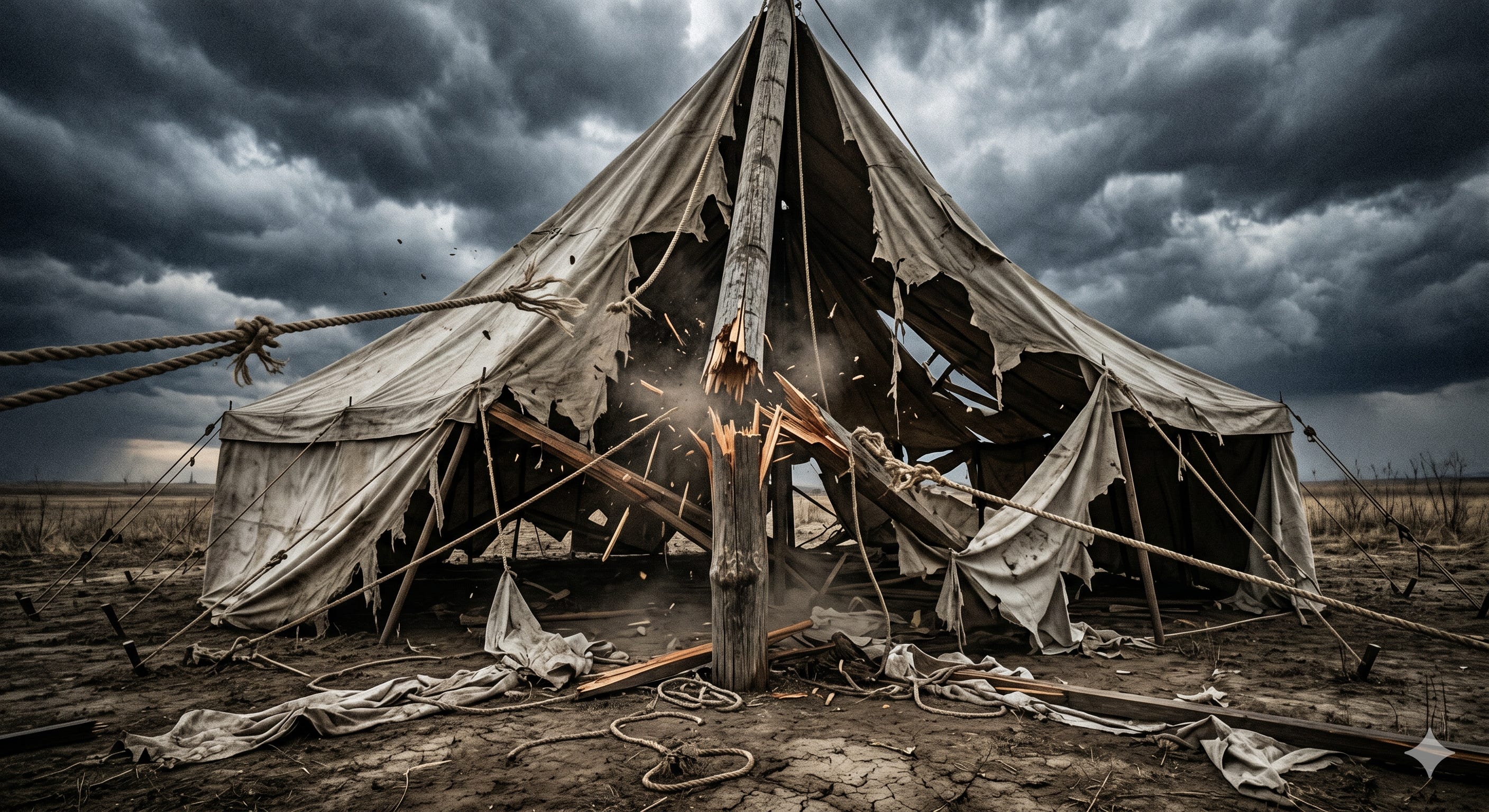
The era of the “uncomfortable coalition” is entering its final act. For decades, the two major American political parties have functioned as “Big Tents,” sheltering everyone from the pragmatic center to the ideological fringe under a single, increasingly tattered umbrella. But we are witnessing the structural collapse of this model.
For far too long, mainstream politicians have attempted to straddle the divide between their moderate bases and their radical flanks. In 2028, that luxury will vanish. The coming election cycle won’t be defined by traditional policy debates over tax brackets or healthcare; it will be defined by a fundamental “purity test” regarding what used to be the ultimate political taboo: the explicit rejection and hatred of the American project itself.
The 2026 Warm-Up: The Mask Slips
The tremors of this shift are already visible in the 2026 midterms. In high-profile primaries across the country, the “Big Tent” is being set on fire from the inside. We see this in the friction surrounding candidates like Abdul El-Sayed in Michigan, who represents a wing of the Left increasingly critical of the very foundations of the American state. Simultaneously, on the Right, the rise of figures like James Fishback in Florida highlights a move toward a brand of populism that flirts with “Great Replacement” conspiracy theories and illiberalism.
These are not mere policy disagreements. They are proxies for a deeper question: Can a party house both those who believe in the American liberal tradition and those who view the United States as an inherently oppressive failure?
The incentive structures of our current system have made this crisis inevitable. Gerrymandering has turned general elections into formalities, moving the real battle to partisan primaries where only the most energized—and often most radical—voters turn out. Candidates, traditionally risk-averse, now live in terror of a vocal online “base” or a media apparatus that thrives on amplifying internal fractures to fuel preferred narratives. Coupled with a “Rage Economy” where national fundraising is driven by extremist provocations, the parties have found it more profitable to court the fringe than to defend the center.
Drawing the Line: Re-Establishing the Ultimate Taboo
To understand 2028, we must define the line being drawn. As I have argued previously, it’s their anti-Americanism, stupid. The new political cleavage is no longer Left vs. Right, but Integrated vs. Oppositional.
The Oppositional Left: This goes beyond progressive reform to demand the dismantling of meritocracy and the police, often accompanied by the uncritical sanitizing of “Death to America” or eliminationist, anti-Israel rhetoric.
The Oppositional Right: This is white supremacy draped in a flag—an illiberalism that views the Constitution as an obstacle rather than a guide. It is fueled by leaders who refuse to denounce conspiracists who dehumanize the “other” as a fundamental threat to the nation’s blood, all while claiming they are simply well-meaning Christians and Americans “just asking questions” and fighting against evil forces.
The greatest sin of current leadership isn’t just that they hold these views, but their uncritical association with those who do. A taboo only holds if a community actively polices its boundaries, but our current leaders have abandoned their posts. We see mainstream Democrats refusing to distance themselves from radicals like Hasan Piker, who have moved from “criticizing policy” to explicitly celebrating those who hate the West. On the Right, we see institutions and leaders refusing to lambaste figures like Tucker Carlson even as he promotes explicit bigotry and argues that America should completely detach itself from Israel. As I wrote in the past, big tents need moral guardrails; this failure to enforce a transitive property of stigma against taboo violators is what has finally rotted the Big Tent beyond repair.
The 2028 Fracture: The Pick-a-Lane Primary
By 2028, the fence will no longer be wide enough to sit on. The candidates currently teased as the future of their respective parties will be forced to choose a side.
Will Alexandria Ocasio-Cortez continue to cozy up to the Piker-wing of the far-left, or will she risk their scorn by defending the basic tenets of American liberalism and security? Consider Gavin Newsom, who, in attempting to appeal to Democrats and Independents nationwide, will face a stark choice: Does he seek to shed his progressive baggage and appeal to the rising, “Abundance-pilled” moderate middle, or does he continue to cater to the vocal, activist minority he is understandably petrified of upsetting?
Neither of them will have the luxury of straddling both ends of this shaky coalition—and it is doubtful anyone else can either. Even a master communicator like Pete Buttigieg, renowned for his flawless, hyper-calibrated answers to every thorny question, will face immediate backlash from his left for showing even a smidge of traditional support for Israel. He will likely attempt to choose the middle lane, trying to gently draw a pragmatic line: “I understand you won’t agree with me on everything, but I vow to work with and represent all Americans—and remember, the alternative is Trump’s chosen successor.” This defensive crouch could work to win a primary, but it is a massive gamble that depends entirely on how the battlefield on the Right shapes out.
On the Right, the fracture is highly likely to happen, but how, where, and when it appears will depend heavily on the next two years and exactly who enters the field. While it is improbable that a mainstream Republican candidate will run for president on an extreme platform of abandoning Israel, the pressure to draw a line will be mechanical.
Consider a potential primary clash between JD Vance and Marco Rubio. If Rubio enters the race, he will naturally occupy the traditional, internationally integrated, constitutionalist lane. As a matter of political survival, Rubio will easily distance himself from Carlson and the isolationist far-right.
This maneuver will force Vance’s hand. Vance will no longer have the luxury of holding out or quietly indulging the “just asking questions” crowd. To maintain any viability in a nationwide general election and counter Rubio’s traditionalist appeal, Vance will be forced to explicitly turn around and denigrate the extreme, isolationist Right. He will have to publicly cut ties with Carlson and the fringe, destroying the very bridge he spent years building. The fracture on the Right will happen not because the extremists win the primary, but because mainstream heavyweights will be forced to publicly exile them to paint the Left as the only side beholden to anti-American radicals. If the Right successfully purges its anti-American fringe, even the Left’s “defensive crouch” will crumble in the general election.
Granted, American politics remains dizzyingly volatile, and shifting global events could quickly redraw these tactical maps. How and when the ongoing war involving Iran concludes, or whether Benjamin Netanyahu is ultimately replaced as Prime Minister in Israel, could entirely reshape the international landscape, offering candidates an unexpected off-ramp or a diplomatic reset.
But the underlying domestic behavior remains structural. When voters walk into the booth in 2028, many will still hold their noses—but their allegiance will no longer be blindly dictated by party ID given how disgusted they’ve become with the explicit hate and anti-Americanism that these “big tents” have allowed in. Registered partisans and moderate Independents make up the largest bloc of the electorate. They may not love the candidate they end up voting for, but they will vote for the person they believe is fundamentally moral and less “anti-American-adjacent.” The winning candidates will be those who realize the silent middle is looking for a leader to say, “You extremists do not speak for this party, and you do not speak for this country.”
Conclusion: The Necessary Rupture
This fracture will be painful. It will lead to civil unrest and a period of profound political instability. But we must accept that appeasement is not a strategy. The normalization of this bigotry and illiberalism within our main political parties is a slow-motion suicide for the republic.
The sooner we make our leaders pick a side, the better. We cannot heal as a nation until we collectively exile these fringe ideologies back to the margins of society and make these taboos taboo again. 2028 will be the year we stop pretending we can all stay under the same tent—and that is exactly what the country needs.
The political parties used to stand for something. Now that will let anyone file for candidacy, apparently trying to enlarge their "big tent." Parties need to have standards. Hate (e.g. racisim, antisemitism, and antizionism, which I argue is just Jew-hate in a new outfit) should render a candidate unfit for office. Also, a basic knowledge of the US Constitution and US History should be required. (Maureen Galindo is a prime example, running for Congress in Texas, displaying both Jew-hate and ignorance of the Constitution and History in promoting that "Zionists should be placed in internment camps.") Second, Americans need to take the primaries seriously. Primaries are to give rank and file Americans a choice. We outnumber the radicals. They are the fringe.